

Oversized Hoodies Compared: Durability vs Fit for Cold Nights
Quick Summary
A durable oversized hoodie combines dense fabric, double-stitched seams and reinforced cuffs with a fit that leaves room for a base layer without excess hem volume. Heavier fleece or cotton knits hold an oversized silhouette well when the construction is sound. Check the construction details, not GSM alone, before you buy.
- GSM measures fabric density but is not a durability score on its own.
- Check double-stitched or flatlock seams at shoulders, armholes and side seams.
- Denser ribbing at cuffs and hem recovers its shape and resists bagging.
- Measure pit-to-pit and allow roughly 10-15 cm of ease over a base layer.
- Wash inside out at 30°C on a gentle cycle and avoid bleach.
Table of Contents
- Why Durability and Oversized Fit Pull in Opposite Directions
- How to Judge Hoodie Durability: Fabric, GSM and Construction
- Side-by-Side: Notix Heavyweight Hoodies Compared
- Getting a Balanced Oversized Fit Without Looking Lost in It
- Temperature and Activity: Which Hoodie for Long Days and Cold Nights
- Washing and Drying a Heavyweight Hoodie So It Lasts
- Choosing the Hoodie to Buy for Your Own Rotation
- Frequently Asked Questions
Why Durability and Oversized Fit Pull in Opposite Directions
Last Updated: 1 November 2026
Most people shopping for a long-lasting hoodie assume heavier fabric is always better. The reality is messier: a heavyweight hoodie that holds its shape for years can swamp your frame if the cut is wrong.
Heavier fabric adds weight and changes how an oversized cut sits on the body.
Durability and fit need not compete. A dense, well-made fleece or cotton knit can carry an oversized silhouette without collapsing into shapelessness. Read why heavyweight fabric lasts longer to see how fabric density and construction affect longevity.
How to Judge Hoodie Durability: Fabric, GSM and Construction
Durability is not a single spec. It is the sum of fabric density, fibre behaviour, seam engineering and hardware quality, and each fails differently. A hoodie rarely dies from one catastrophic failure; it wears out at the points that take the most abrasion and tension.
Fabric weight and density: what GSM does and does not tell you
GSM (grams per square metre) measures how much fabric is packed into a square metre. It is the easiest number to compare across products, and it correlates loosely with warmth, opacity and shape retention.
GSM is not a durability score. A heavy fabric knitted from short, loosely twisted yarn can pill and thin faster than a lighter fabric made from long-staple yarn with a tight knit.
Fibre content: how cotton, polyester and blends age
Each fibre fails in a characteristic way, and that matters for long days and cold nights.
- 100% cotton breathes well and takes dye deeply, but absorbs moisture and dries slowly. When damp, fibres weaken and the garment can stretch at stress points. It also pills where friction is highest, typically under the arms and along the cuffs.
- Polyester adds tensile strength, resists stretching and dries quickly, which is why it is common in fleece blends. Its weakness is odour retention and, in brushed fleece, surface pilling.
- Cotton-polyester blends combine the properties of both fibres.
For a garment worn through long days and into cold nights, the practical question is not which fibre is 'best' but which failure mode you can live with. Pure cotton suits people who prioritise breathability and accept more careful laundering; a dense blend suits people who want the hoodie to keep its silhouette with less intervention.
Construction checks that predict longevity
These are the details worth inspecting on any heavyweight hoodie, whether in person or via product photography and descriptions:
- Seam type and stitching density. Look for double-stitched or flatlock seams at the shoulders, armholes and side seams. Sparse, single-row stitching at high-tension points is the first thing to fail.
- Reinforced stress points. Bar tacks or extra stitching at pocket mouths and drawstring exits show the maker has thought about wear.
- Rib quality at cuffs and hem. Ribbing should feel dense and recover its shape when stretched. Thin, loose ribbing bags out within a season.
- Hood structure. A two- or three-panel hood holds its shape better than a single-piece hood, and a lined hood adds warmth without much weight. Metal eyelets and a substantial drawstring outlast plastic or glued alternatives.
- Zip quality (on zip-up styles). A metal or quality nylon zip with a sturdy pull is repairable; a cheap coil zip that separates is often a write-off. Check that the zip tape is stitched, not glued.
- Abrasion resistance where it counts. Cuffs, elbows, pocket edges and the hem rub against surfaces all day. Denser knit structure and reinforced panels here extend life more than a higher overall GSM does.
- Repairability. A garment with standard construction and accessible seams can be repaired for years; one with glued or fused construction often cannot.
Matching durability to long days and cold nights
Durability and warmth are related but not identical. A dense fabric holds warmth and resists wear, but warmth over a long cold night also depends on loft, layering and moisture management. The 500 to 530 GSM options in the range are the heavier pieces, while the 400 to 410 GSM pieces are the lighter layers. The right choice depends on whether the hoodie is your outer layer or a mid-layer.
care labelling guidance for cotton and cotton-blend garments
Side-by-Side: Notix Heavyweight Hoodies Compared
Here is how the current Notix heavyweight hoodies compare on their listed specs. You can view the Essential Heavyweight Hoodie to check its full details and buy.

| Hoodie | Fabric | Price | Best For |
|---|---|---|---|
| Essential Heavyweight Hoodie | Cotton-blend fleece (53.75% cotton / 46.25% polyester) | £44.99 | Everyday wear across spring, autumn and winter |
| Essential Heavyweight Fleece Hoodie | Cotton-blend fleece (53.75% cotton / 46.25% polyester) | £44.99 | Pairing with matching trousers for a full set |
| Worldline Washed Zip-Up Hoodie | Heavyweight fleece | £47.99 | Layering with a full-length zip and vintage finish |
| Brick Snow Wash Hand-Frayed Hoodie | 100% cotton | £49.99 | Cotton lovers who want a worn-in, individual look |
| Varsity Heavyweight Hoodie (Black / Green) | 100% cotton | £49.99 | Maximum weight and structure for heavy daily rotation |
Best for: Heavier daily wear, the 530 GSM Varsity hoodie is the heaviest option in the range.
Skip if: You want a lighter layer. The 400 GSM Brick hoodie or the 410 GSM fleece zip-up is the lighter option.
Getting a Balanced Oversized Fit Without Looking Lost in It
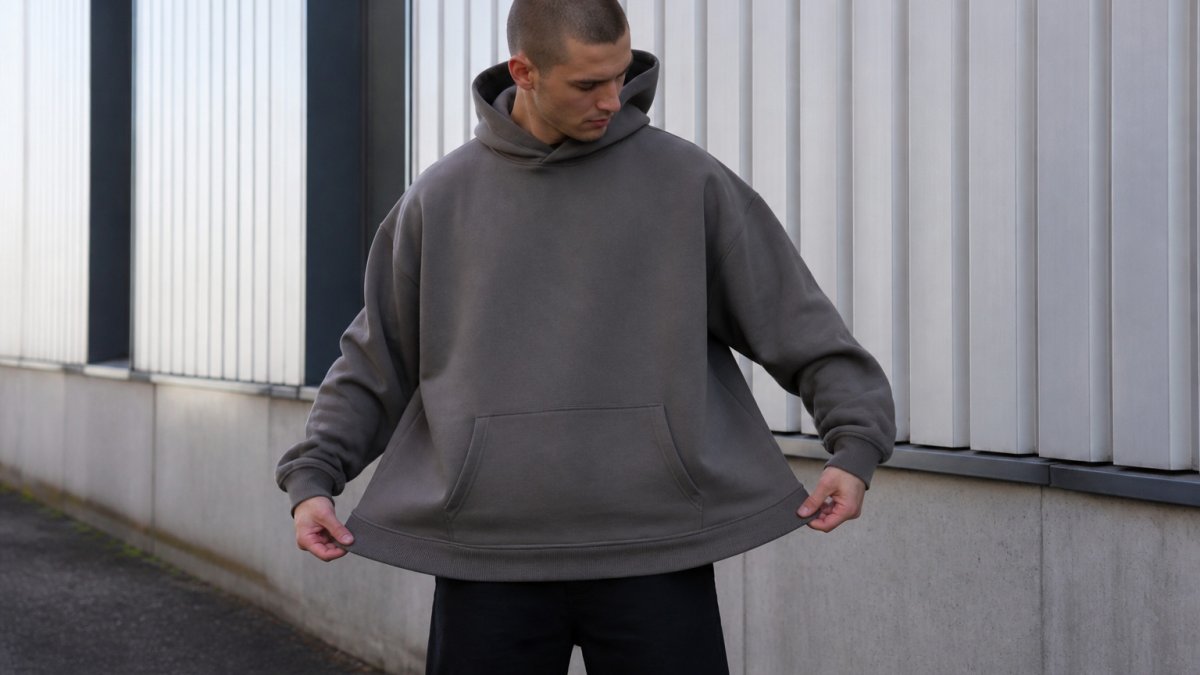
Oversized is a proportion decision, not a sizing decision. Balance is what separates a hoodie that looks deliberate from one that looks borrowed. Cold-weather layers change how an oversized cut behaves: a silhouette that looks right over a T-shirt can become restrictive over a base layer and a mid-layer, or so roomy that cold air circulates and warmth is lost.
The three measurements that actually control balance
Ignore your usual label size and work from three measurements, comparing them against each product's size chart:
Notix Essential Heavyweight Hoodie →
- Chest (pit-to-pit). This sets how much room you have for layering. As a rule of thumb, an oversized hoodie should give roughly 10-15 cm of ease over your bare chest measurement if you plan to wear it over a base layer only, and more if it must accommodate a mid-layer. Too little ease and the oversized look collapses into a regular fit; too much and the fabric hangs away from the body, creating draughts.
- Shoulder-to-shoulder and drop-shoulder point. A drop-shoulder seam sits below your natural shoulder. The further it drops, the more relaxed the silhouette, but past a point the sleeve head loses structure and the armhole restricts reach. Check where the seam lands relative to your shoulder bone and whether the sleeve still allows a full overhead reach.
- Body length and hem coverage. For cold days, the hem should cover the waistband of your trousers when standing and still cover it when you reach overhead. A cropped oversized hoodie leaves a cold gap when you layer and move.
How oversized fit interacts with layering and heat loss
An oversized hoodie is not automatically warmer. Extra room at the hem, cuffs and neck lets warm air escape and cold air enter, which is why a balanced fit matters more in cold conditions. The aim is enough room for a base layer and, if needed, a thin mid-layer, without so much volume that the garment bellows.
A practical sequence is to test the hoodie over the layers you will actually wear. Put on your usual base layer, add the hoodie, then check:
- Shoulder reach. Raise both arms overhead. The hem should not ride up past your waistband, and the armholes should not dig into your shoulders.
- Sleeve length. With arms at your sides, the cuff should sit at or just past your wrist bone. When you reach forward, the sleeve should not pull the body up.
- Hem and draughts. Bend forward and twist. If cold air rushes up the back, the fit is too loose at the hem or the body is too short.
- Cuff and neck seal. Ribbed cuffs and a close-fitting hood or collar trap warmth. Loose cuffs lose heat at the wrists regardless of fabric weight.
- Outer-layer compatibility. If the hoodie will sit under a jacket, put the jacket on over it. The hoodie should not bunch at the shoulders, and the jacket should still fasten without strain.
Proportion tricks that keep an oversized top looking intentional
Balance the silhouette by keeping the lower half closer to the body. Straight or tapered trousers work with a heavy oversized top because they narrow the leg line and stop the outfit reading as uniformly wide. The oversized fit guide for men covers sizing and styling in more depth.
Footwear and outerwear also affect perceived balance. A bulky hoodie over slim trousers and a low-profile shoe reads as considered; the same hoodie over wide trousers and a chunky boot can read as accidental.
Fit testing before you commit
If you are buying online, use the size chart and stated measurements rather than assuming your usual size. Compare pit-to-pit, body length and sleeve length against a hoodie you already own and like. If the measurements sit between two sizes and you plan to layer, size up; if you will wear it as a standalone outer layer, stay with the size that gives you the ease you want without excess hem volume.
Temperature and Activity: Which Hoodie for Long Days and Cold Nights
The lighter 400 to 410 GSM pieces are the lighter options in the range, and the 500 to 530 GSM pieces are the heavier options.
Activity level also changes the choice. If you are moving around a lot, breathable cotton reduces sweat build-up. If you are mostly sitting or standing in the cold, the denser blend holds warmth better. Layering a heavyweight hoodie under a jacket gives flexibility when conditions change.
Washing and Drying a Heavyweight Hoodie So It Lasts
Gentle care helps heavyweight hoodies keep their condition. Wash inside out at 30°C on a gentle cycle, and do not bleach. Turning printed pieces inside out protects the graphics. For a step-by-step breakdown, see the detailed washing guide for heavyweight cotton hoodies.
Tumble dry on low if you can. Iron on a low setting and avoid placing the iron directly over prints. Do not dry clean.
Wash with similar colours.
Choosing the Hoodie to Buy for Your Own Rotation
Start with how and where you will wear it most. If it is your daily cold-weather layer, the 530 GSM Varsity or the 500 GSM Essential fits suit heavy use.
Next, check the fit against your measurements, not your usual label size.
Choose the weight and fibre that match your climate and routine, then build the rest of your wardrobe around it.
Frequently Asked Questions
Which hoodie fabrics are most durable for everyday wear?
Heavier cotton and cotton-blend fleece tend to last longest because the tighter knit resists pilling and stretching. Notix offers heavyweight hoodies in the 400 to 530 GSM range, such as the Brick Snow Wash at 400 GSM and the Varsity at 530 GSM. Check the fabric weight and composition on the listing before buying, and expect the fleece-based options to feel softer and warmer while the 100% cotton pieces hold a firmer structure over time.
What makes a heavyweight hoodie warm enough for cold evenings?
Warmth comes mainly from fabric weight and the amount of brushed fleece on the inside. The Essential Heavyweight Fleece Hoodie uses a 500 g/m² cotton-blend fleece, and the Worldline Washed Zip-Up uses a 410 GSM fleece with a soft brushed interior. Pairing either with a base layer underneath and a shell over the top is one way to layer the piece.
How should an oversized hoodie fit without looking too baggy?
Look for a drop-shoulder cut where the seam sits just off the natural shoulder, and check the chest and length measurements against a hoodie you already own. The Varsity and Brick hoodies are listed as oversized fits, so check the size chart and measure your chest before choosing a size.
How do you wash a heavyweight hoodie without damaging it?
Wash at 30°C on a gentle cycle, inside out and with similar colours, and avoid bleach. Tumble dry on low or air dry flat to protect the fleece and the print. Iron on a low setting and never directly over printed areas. Following the care instructions on any NOTIX hoodie is recommended.
